Artificial intelligence is already being used across healthcare for purposes including diagnostic imaging, clinical decision support, triage and note-taking.
As its use expands further, questions around responsibility, evidence and clinical decision-making are becoming increasingly relevant to medico-legal practice.
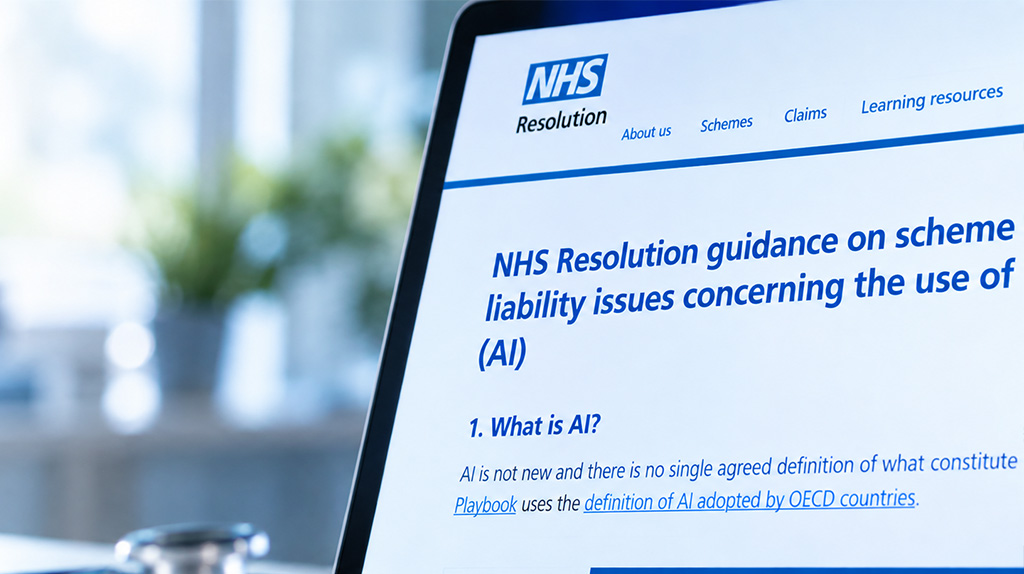
On 10 September 2026, NHS Resolution published new guidance on indemnity and liability where AI-enabled technologies are used within NHS care. NHS Resolution released this guidance specifically to complement the launch of the National Commission into the Regulation of AI in Healthcare report on the same day.
The guidance provides practical clarification on how existing clinical negligence arrangements apply to AI, what NHS organisations should consider when adopting new systems, and the evidence that may be needed if an AI-related clinical negligence claim arises.
Its publication is particularly timely. Just one day later, Health Service Journal reported that the NHS had received its first clinical negligence claims in which the use of artificial intelligence is a potential factor.
AI remains a tool, not a substitute for clinical judgement
NHS Resolution’s guidance covers a wide range of uses for AI in healthcare, from diagnostic tools and predictive analytics to treatment recommendations, triage systems and automated note-taking.
A central principle in the guidance is that AI should support clinical practice and decision-making rather than replace professional judgement, unless a system has specifically been authorised to operate differently.
Existing NHS Resolution indemnity schemes will continue to cover NHS clinical services where AI is being used.
The clinician’s duty of care remains
An important point is that the introduction of AI does not remove the clinician’s existing duty of care.
NHS Resolution states that the established principles governing breach of duty in clinical negligence claims continue to apply. Clinicians using AI to assist with diagnosis, treatment or care must still be satisfied that the result or recommendation is clinically appropriate.
In a future claim, questions could therefore include:
- Did the clinician appropriately rely on the AI output?
- Was independent clinical judgement exercised?
- Was the system used in accordance with its training, guidance and regulatory approval?
- Were known limitations of the AI system or performance concerns taken into account?
NHS Resolution also notes that claims are much more likely to be pursued against the treating NHS organisation than directly against the developer or manufacturer of the AI system.
Product liability may still become relevant where harm results from a failure or malfunction of the technology, creating the potential for claims involving several parties and different areas of liability.
What evidence could be required?
For medico-legal practitioners, one of the most significant parts of the guidance concerns records and evidence.
Where AI has influenced a clinical decision, understanding what happened may require more than reviewing the conventional patient record.
NHS Resolution recommends that organisations retain clear audit trails showing how AI outputs were considered and record the reasons why clinicians followed or overrode recommendations.
Organisations should also maintain information showing which AI systems were being used at a particular time and, importantly, which version of the technology was in operation, as some AI tools can experience “drift” or performance changes over time.
Depending on the circumstances, relevant evidence could therefore include:
- the AI output or recommendation;
- the information provided to the system;
- the clinician’s subsequent decision and reasoning;
- whether the recommendation was followed or overridden;
- the particular AI tool and version being used;
- relevant training and guidance provided to staff;
- known limitations or performance concerns;
- audit logs and monitoring information.
This may become important when medical experts are asked to reconstruct how a decision was reached.
The underlying clinical question remains familiar: was the care provided reasonable in the circumstances?
But where technology formed part of the pathway, an expert may also need to understand what information the clinician received from that technology and how it contributed to the final decision.
The importance of recording clinical reasoning
The guidance places particular emphasis on documenting clinical reasoning alongside the use of AI.
That could be significant in claims where an AI recommendation was either followed or rejected.
For example, if an AI-supported diagnostic tool identifies a possible abnormality but the clinician reaches a different conclusion, the medical record may need to demonstrate why that decision was made.
Equally, following an AI recommendation does not necessarily establish that the subsequent clinical decision was reasonable. The clinician must still exercise professional judgement.
For solicitors and experts investigating an allegation of negligence, the relevant question may therefore become not simply “What did the AI recommend?”, but “How did that recommendation influence the clinical decision?”
Clear contemporaneous records will be important in answering that question.
Governance may also form part of the evidential picture
NHS Resolution’s guidance extends beyond the actions of individual clinicians.
Healthcare organisations are advised to maintain appropriate governance frameworks when introducing AI, ensure contractual arrangements with suppliers address responsibility and liability, and retain records of permitted AI uses.
Staff training is also highlighted.
Where a claim involves the use of AI, evidence showing that clinicians understood the purpose, limitations and correct use of the technology may help establish whether appropriate governance was in place.
Organisations are also advised to monitor the continuing performance of AI systems.
The first claims are beginning to emerge
The publication of the guidance coincides with reports that the NHS has now received its first clinical negligence claims involving AI as a potential factor.
Health Service Journal reported on 11 September that NHS Resolution had confirmed receiving a small volume of clinical negligence claims in which the use of AI in delivering patient care is a potential factor. NHS Resolution did not provide further details of the individual claims because of the risk of identifying those involved.
The existence of these claims does not in itself establish that patient harm occurred or that AI was the principal cause.
However, their existence is significant.
Until now, much of the discussion around AI and clinical negligence has focused on how existing legal principles might apply if technology contributed to patient harm.
Claims are now beginning to test those questions in practice.
There is still no established body of UK case law determining the standard of care where clinicians rely upon AI systems. NHS Resolution acknowledges that this area of law is continuing to develop.
For that reason, early claims may provide important insight into how courts, experts and claims handlers approach the relationship between clinical judgement and technological support.
What this means for medico-legal practice
AI has considerable potential to support healthcare professionals, improve efficiency and help clinicians process increasingly complex information.
The publication of NHS Resolution’s guidance should therefore not be seen as an argument against its use.
Instead, it reflects the need for accountability and good evidence as AI becomes more established within clinical pathways.
For solicitors, insurers and medical experts, future AI-related claims may require consideration of both the clinical evidence and the digital systems that informed the care provided.
The key principles remain familiar: decisions should be clinically justified, records should explain how those decisions were reached, and expert evidence should be based on a clear understanding of the information available at the relevant time.
What is changing is the range of evidence that may be needed to establish that picture.
As the first AI-related clinical negligence claims begin to emerge, clear records, transparent clinical reasoning and reliable audit trails are likely to be increasingly important in understanding how technology influenced patient care.
Sources
- NHS Resolution, Guidance on scheme coverage and liability issues concerning the use of Artificial Intelligence (AI), published 10 September 2026.
- NHS Resolution, NHS Resolution supports publication of national AI Commission report, 10 September 2026.
- Health Service Journal, First AI clinical negligence claims lodged, 11 September 2026.
- UK Parliament, written answer HL841, Artificial Intelligence: NHS Clinical Decision-making, answered 17 June 2026.